

£0.00
Checkout-60%


- Product Code: vacs
- Availability: In Stock
£299.00
£745.00
- Product overview
- Reviews (1)
- Related products
Suggested uses based on feedback from real users:
1. Dental practice
• Reduces the risk of airborne infections
• Reduces blood splatter
• Reduces the amount of patients' saliva inhaled via aerosol
• Reduces the risk of lung diseases amongst dentists
• Removes fine particles with the aerosol, which are too small for face masks and are otherwise inhaled and accumulated in the lungs over the years
2. Dental laboratory dust capture (light to moderate use)
Good for:
• Acrylic trimming
• Plaster
• Light grinding
• Polishing dust
Tips to make it work better:
• Short, wide hose
• Keep bends minimal
• Clean/upgrade filters regularly (HEPA if possible)
• Use it close to the source (10–15 cm)
⚠️ Not ideal for:
• Heavy ceramic milling
• Silica-intensive work
• Continuous high-load suction
3. Bench-top fume & odour extraction
Surprisingly good for:
• Monomer fumes
• Resin 3D printing odours
• Wax fumes
• Light soldering fumes (not heavy metal vapours)
Add-ons that help:
• Activated carbon filter
• Hood or capture funnel at the bench
4. Resin & 3D printing station
A popular post-Covid reuse:
• Place near SLA/DLP printer
• Capture resin fumes
• Add carbon + HEPA combo filter
Much quieter than industrial extractors.
5. Localised cleaning suction (not a vacuum replacement)
Good for:
• Workbench debris
• Chairside cleanup
• Dust control during hand grinding
Not good for:
• Large debris
• Wet materials
• Continuous suction for long periods
6. Home
• removal of cigarette or other unpleasant smoke
• air purification (although smaller and more specialised units would be more appropriate for this)
Summary:
Extra-oral suction units are best reused as:
✔ Local dust control
✔ Fume & odour extraction
✔ Quiet bench-top capture
Full description:
✔ Reduces the risk of lung diseases amongst dentists (removes fine particles with the aerosol, which are too small for face masks and are otherwise inhaled and accumulated in the lungs over the years)
✔ Makes your AGP procedures safer
✔ Reduces blood splatter
The risks of respirable particles in dentistry have been acknowledged for sixty years. Most dental activities produce dust or air sprays. This includes everything from preparing a cavity to mixing alginate.
Respirable particles are particles small enough to be inhaled into your lungs. They can have wide and varied impacts on your health. Some of these particles are small enough to pass through the standard face mask. Human body has processes to remove particles from your lungs but this is a lengthy process. Most particles that land in your lungs will be wafted out by the cilia on the wall of your lungs in the form of a "bogey". However, if a particle is small enough to land in your alveoli, it must be phagocytosed by a white blood cell. This can take months. If overloaded, these processes will stop. Inflammation is the result and damage to your lungs will follow, hampering your ability to breathe – with possibly disastrous effects on your health.
There are numerous articles and studies about lung diseases among dentists. Should you be interested, just send us an email and we will send you some of those articles.
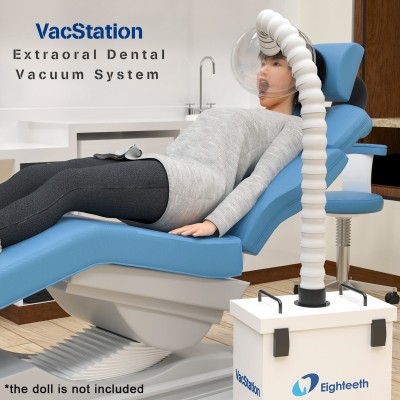
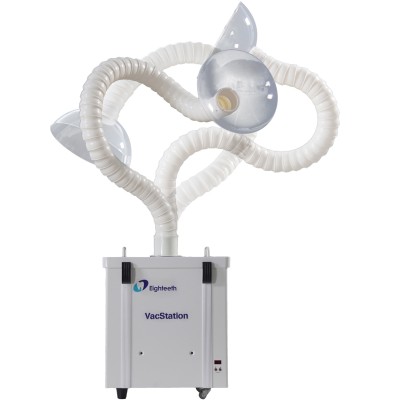
VacStation Extra-oral Dental Suction System has been developed by Eighteeth to reduce the risk associated with airborne particulates and pathogens present in an aerosol spray that is an inherent part of dental care. The aerosol emerging from the mouth of the patient consists of splashes of the spray mist rebound and droplets containing cooling water, saliva, blood, microorganisms, bacteria, and viruses. This mixture presents a high risk of infection.
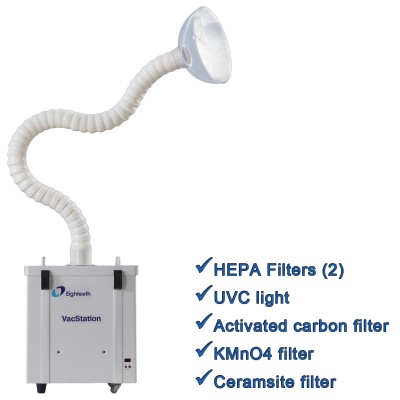
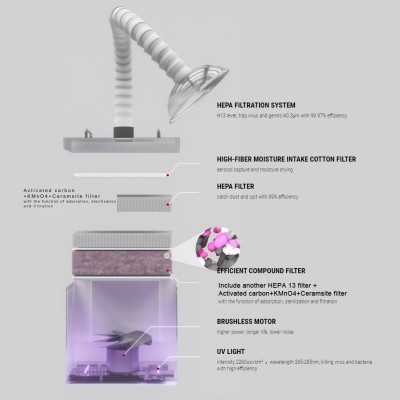
VacStation reduces that risk and purifies the air using a multi-level filtration system (HEPA, High-fiber cotton filter, Activated carbon+KMnO4+Ceramsite filter+2nd HEPA 13), and UV C light. It traps viruses and germs ≥0.3 μm with over 99.97% efficiency, including mercury vapor.
An independent evidence-based study has found that using the VacStation highly reduces the risk of infection.
SARS-CoV-2: characterisation and mitigation of risks associated with aerosol generating procedures in dental practices - British Dental Journal (2021)
A clinical study measuring dental aerosols with and without a high-volume extraction device - British Dental Journal (2020)
99.9% kill rate of of Influenza A virus H1N1 - picture.
Reduction of aerosol particles during crown preparation with VacStation - picture
“A good intra oral suction unit plus extra oral unit combined together would remove bulk of the aerosol in the micro environment. So the macro purification benefit of a unit like Radic8/ Q7 would offer some marginal benefit, but will not be enough to deal with the aerosol generated in an average surgery.”
Ref: Emmoms L. Wu C , Shutter T 2017 / Dr V J Vadgama , Woodbury Dental and Laser Clinic, www.woodburyclinic.co.uk
Studies have shown that nasal swabs from patients with symptomatic or asymptomatic Covid-19 exhibit higher viral concentrations than those in throat swabs. High volume aspirator would not protect against viruses exhaled by patients through the nose. Extraoral vacuum aspirators (EOVAs), like VacStation, deal with both aerosol droplets and viruses exhaled through the patient’s nose.
Even a modified household vacuum is “highly effective in preventing air contamination by dental procedures” link ResearchGate
Why choose our unit?
• Similar units available on the market usually only have HEPA filters and UV C light. VacStation has 2 HEPA 13 filters, High-fiber cotton filter, Activated carbon, KMnO4, and Ceramsite filter, plus a medical-grade UV C light. Covid-19 can go through HEPA filters and exposure time to UV radiation might not be sufficient in units containing only a HEPA filter,
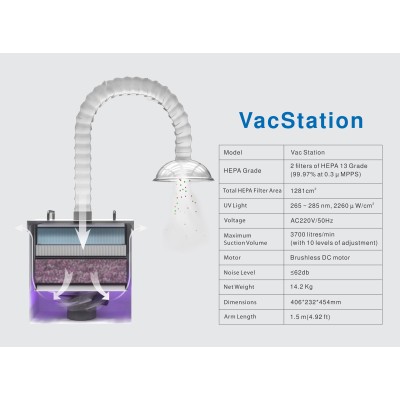
• Total filter area of 1281cm2: Larger area of filter equals larger area for contaminated air to pass through. This results in better filtration,
Why choose our unit?
• Similar units available on the market usually only have HEPA filters and UV C light. VacStation has 2 HEPA 13 filters, High-fiber cotton filter, Activated carbon, KMnO4, and Ceramsite filter, plus a medical-grade UV C light. Covid-19 can go through HEPA filters and exposure time to UV radiation might not be sufficient in units containing only a HEPA filter,
• Total filter area of 1281cm2: Larger area of filter equals larger area for contaminated air to pass through. This results in better filtration,
• Manufactured by an ISO certified company with a proven record of highly effective and reliable products (example: E-Connect S endomotor),
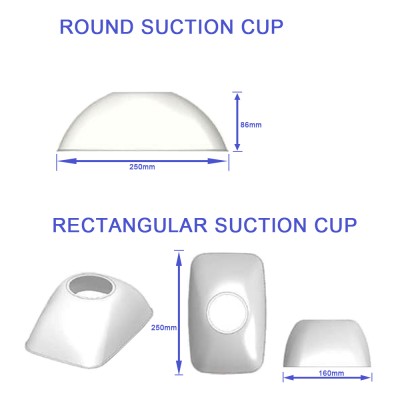
• 2 suction cups of different sizes included. A small diameter suction cap present in some other units found to be less efficient in capturing the aerosol,
• Freely movable arm offers ease of access and the suction cup can be positioned at virtually any angle.
• Brushless motor: quieter, longer-lasting, less power consumption,
• Medical grade UV C light with 10000 hrs of operation time (10000 hrs equals to over 6 years of 220 days per year use, 7hrs per day)
• Lighter (14kg) than many other units, and portable (wheels). This means that you can easily move it between rooms, so you can only have it where AGPs are performed.
• Cost-effective: unbeatable price at around half the price of similar units available on the market.
• Lighter (14kg) than many other units, and portable (wheels). This means that you can easily move it between rooms, so you can only have it where AGPs are performed.
• Cost-effective: unbeatable price at around half the price of similar units available on the market.
Did you know:
• Over 600 different types of bacteria can be detected in the human oral cavity (Source: Genome Research (2009), DOI: 10.1101/gr.084616.108)
• 1 ml saliva contains about 10 million bacteria (Source: Genome Research (2009), DOI: 10.1101/gr.084616.108)
• During a 15-minute treatment without protective measures, approx. 0.014–0.12 µl of saliva is inhaled via the aerosol (Source: Bennet et al. British Dental Journal, Vol. 189 No. 12 (2000))
• Deposition of a contaminated spray mist cloud over a radius of several meters (Source: Drisko et al., 2000, Bennet et al., 2000)
• Over 600 different types of bacteria can be detected in the human oral cavity (Source: Genome Research (2009), DOI: 10.1101/gr.084616.108)
• 1 ml saliva contains about 10 million bacteria (Source: Genome Research (2009), DOI: 10.1101/gr.084616.108)
• During a 15-minute treatment without protective measures, approx. 0.014–0.12 µl of saliva is inhaled via the aerosol (Source: Bennet et al. British Dental Journal, Vol. 189 No. 12 (2000))
• Deposition of a contaminated spray mist cloud over a radius of several meters (Source: Drisko et al., 2000, Bennet et al., 2000)
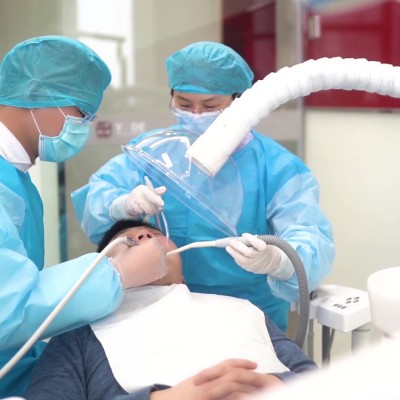
VacStation in use:
